
It’s apparent from my feeds that I have visual diarrhea. I have been taking photos in all different formats for over 35 years expressing myself in a creative way visually since my high school art teacher handed me a 35mm camera with the statement ‘you need to look through the lens and capture what your eyes see’. Thank you, Mr. Hughes. I think visually and if you see me staring off with a blank look it’s likely because I’m seeing something in that moment, in my head or in front of me and processing how to capture that split second in a way that is visually interesting. A practice I call Zen Photography and it is a visual memory photograph that I internally say to myself ‘remember this view, every fine detail of this view and don’t ever forget it’. There are times I think my Zen Photo Album has taken up so much space in my brain that I’m going to have to download other less important things like passwords and such to free up space.
One would think that a trip to Africa to climb Kilimanjaro, the highest freestanding mountain in the world, would be a photographer’s wet dream. Well, it was, and it wasn’t, and my Zen Album only got larger.
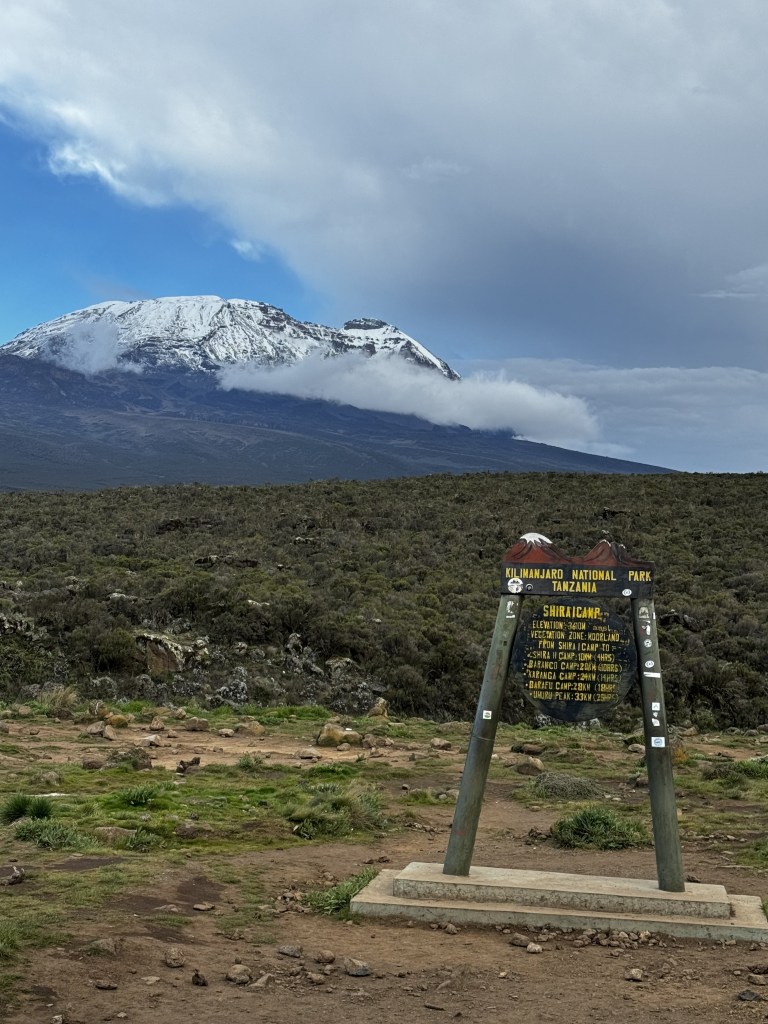
It’s been 8 months since I stood on the roof of Africa at Uhuru Peak on Kilimanjaro 19,341 feet above sea level. I look at the pictures of myself and can see my exhaustion, even before we started the hike, the travel days to get to Tanzania was nothing short of a nightmare. Toronto to Zurich – Zurich to Cairo (where we had a 9-hour layover in airport purgatory due to visa issues) – Cairo to Addis Ababa, Ethiopia – Addis Ababa to Kilimanjaro. Two full days travel with stupid layovers in less than stellar airports. We survived and are better travellers for it, I think. I travelled with my older brother Kevin and his long-time friend Cory.
I’m posting this now as a reflection on what I saw, but not necessarily captured with a camera. Verbal diarrhea over visual – not the norm for me. Every waking moment in Africa was visually stunning. The moments I remember that I have captured in my head, my zen photography moments where I didn’t have the energy to pull out my phone (everything I did shoot was on an iPhone 15 Pro Max) will stay with me forever in the album in my brain. Flying into Addis Ababa, you come in around a small mountain over barren African land to see an intricate and vast metropolitan city, I replay that view in my head often. The view driving through Marangu on the Kilimanjaro foothills into the Mhabe Farm and seeing the Chagga people walking uphill, even pulling carts with ease at this elevation. This village sits at 6,102 feet above sea level, and for me living at 738 ft here in Muskoka it seemed like the air was already thin.

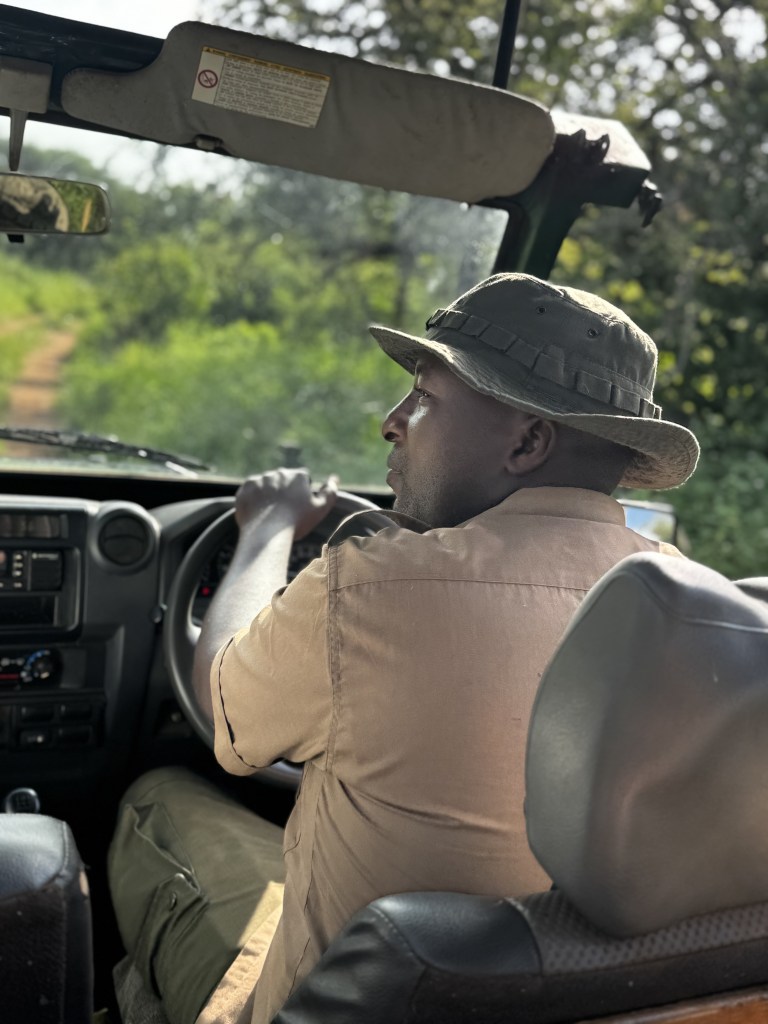
We had the opportunity to take a short safari before heading to the mountain. I had the energy and time to take amazing pictures, and I did take a few – specifically the giraffe and elephant that graced us with their presences, the amazing scenery, and the most interesting park rangers taking us through the Black Rhino Sanctuary. The ranger tracking the beasts was most stoic and serious about his job. The grasses were so high from an unprecedented amount of rain that the rhinos had too many places to hide, we did not find even one black rhino on that day. In hindsight this is good for the rhino because they are poached often and on the endangered list. This Sanctuary has a pregnant female and a newborn, so I am thankful it exists and that countries like Tanzania and Kenya are protecting these creatures. I do not have a zen photo or an actual picture of a black rhino, and while that is disappointing, I do have one of the Head Ranger of this park who had the kindest eyes and drove around the 3,270 square km enclosure for three hours in an attempt for us to spot the majestic beast. He was visibly upset when we had to give up, and I felt a great sense of admiration for the man in that moment, his pride slightly wounded as he explained in Swahili that in his entire park ranger career, he has never not tracked the rhino for a tour.

We were on the mountain for a total of 8 days. Six days of climbing up in elevation and a two-day fast trek heading down. On day one I learned three things – the first was that I was very naive about taking the long slow route up the mountain – The Lemosho Route – my naivety in thinking that the first two days of trekking through the rainforest would be leisurely. It was anything but leisurely. It was a gruelling two days in hot humid weather trekking up and over the foothills of Kilimanjaro – up mud walls grasping on branches and steep step ups until we eventually came to the Shira Plateau, the next ecological zone. The second, that my physical and mental preparation wasn’t enough, while it was in the long run as I made the summit and survived, those first two days kicked my ass all over that rainforest. My legs and lower body performed well (yeah CrossFit), and I smiled with a bit of smugness that I didn’t have to do weeks and weeks of rucking with a weighted vest or spend hours on the stairmaster, my physical fitness shone through. What fucked with me those first two days was my breathing, I had studied and trained a breathing technique for stability that would brace my steps on a 5-pace count. It worked great on the treadmill, as well hiking and walking at home. I could not fit it in with the POLE POLE pace our mountain guides Octavian and Emmanual had us walking. The pace was slower and more deliberate. I fought it for two days and when I finally let go of my ego and didn’t try so hard I fell into a three-count pace that allowed me to catch my breath easier and not get so winded. I knew it would just get harder the higher we went up, and I had moments of panic attacks thinking a helicopter rescue was in my future.
The third thing I learned that first day in a mental fog slugging through with a scattered brain was that this trip wasn’t just a bucket list trip. It had been a 50th birthday idea for some time, but it morphed because I was in a different place in 2023 with losing Rob. Training for the climb was therapy, coming to Africa was a sort of pilgrimage, and climbing to the peak of Kilimanjaro just before the anniversary of his death was letting go and becoming a new version of myself. It was now 2024 and I had made it through, reaching 19,341 feet symbolized my progress.

The following four days of climbing through the plateau, up the Barranco Wall (a two kilometer scramble up a rock face that was a terrifying for someone with vertigo) and leading up to summit night were mostly me watching the feet of Octavian or Emmanual depending on who was leading, matching their pace and placing my foot exactly where they placed theirs. Every step was deliberate. My phone tucked away, no Instagram stories, no Facebook posts, no texts home to friends and family. I would snap a picture if we stopped on breaks, but rarely did I have my phone in hand when my feet were moving forward. At camp you would see the porters perched on rocks with phones getting a signal so they could connect with family, we did the same and could usually get enough of a signal to get a message through to say where we were and how we were doing.

For summit night it was decided that we would skip past Karanga Camp and head right to Barafu (15,331 feet). We arrived there at 11:31am on the morning of January 30. Camp was ready for us; we had an amazing team of porters that always reached the next camp before us with all the gear and camp equipment. Whenever we arrived at a camp it was set and ready for us, and either lunch or dinner was waiting. All the food was supplied from the Mhabe Village, the home village of Simon Mtuy, the owner of the SENE tour company we hired as our guides. SENE was high on the list because they are a Tanzanian based company, and they employ local guides, and porters as well as supporting their village by purchasing all food supplies right from the farmers in the village. Even our morning coffee was grown and roasted right on the farm. Seeing all the big logoed tour companies scattered across the camps each night with 20+ hikers in each group made the decision to use SENE feel right. Being ethical with our climb made it a better journey, not to mention having Simon share his stories before and after our trek as he is the world record holder for the fastest unassisted ascent and descent of Kilimanjaro. A trek that took us 8 days took him 9 hours. An amazing feat even for an elite Tanzanian runner who has lived his life at higher elevation on the foothills of Kilimanjaro.

With summit night looming we slept the afternoon, Godfrey our server/porter woke us for a short dinner at 5:30pm and then promptly sent us back to bed. We were woken again at 11:30pm, we had 30 minutes to get geared up and off we went. The trek up to the first checkpoint, Stella Point (18,885 feet) was mentally gruelling, switchback walking through the dark, around boulders and with winds smacking you in the face. The only thing I could see was the guide’s feet in front of me and loose lava gravel on the ground. Head down walking uphill for 6 hours counting – 1,2,3 – each foot a small step forward, repeatedly counting to three. It is how I survived. I never counted higher than three, it was a lather, rinse, repeat cycle of mentally surviving and waving off a panic attack that sat promptly in my chest making it hard to breath, although that was likely the altitude.
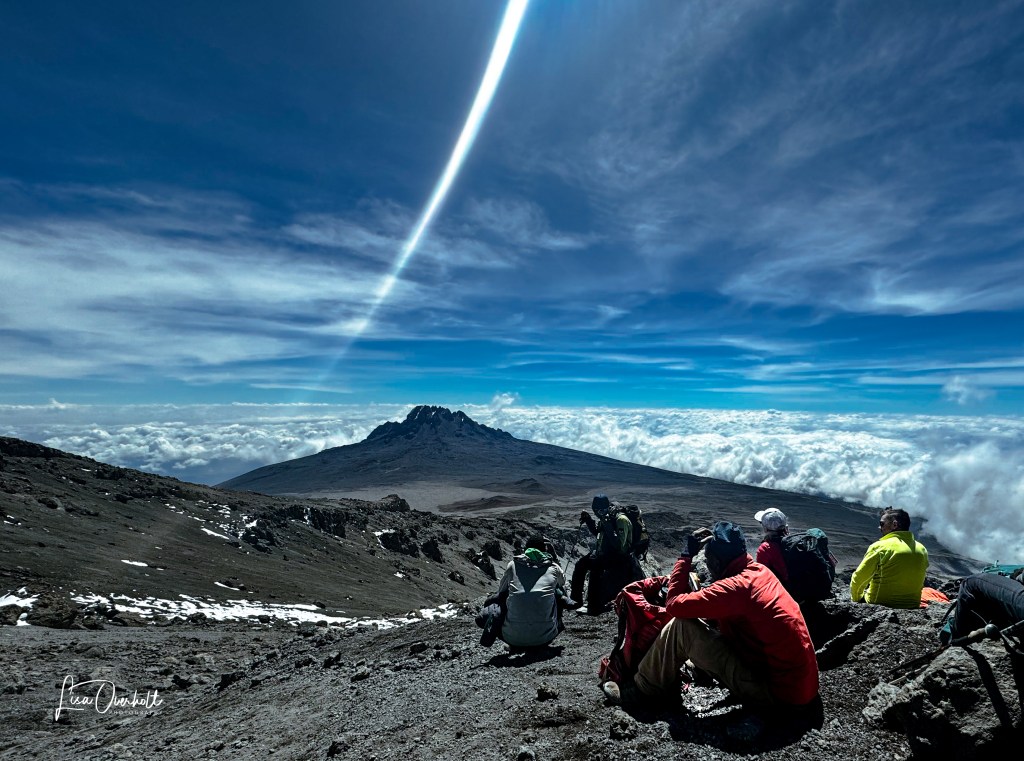
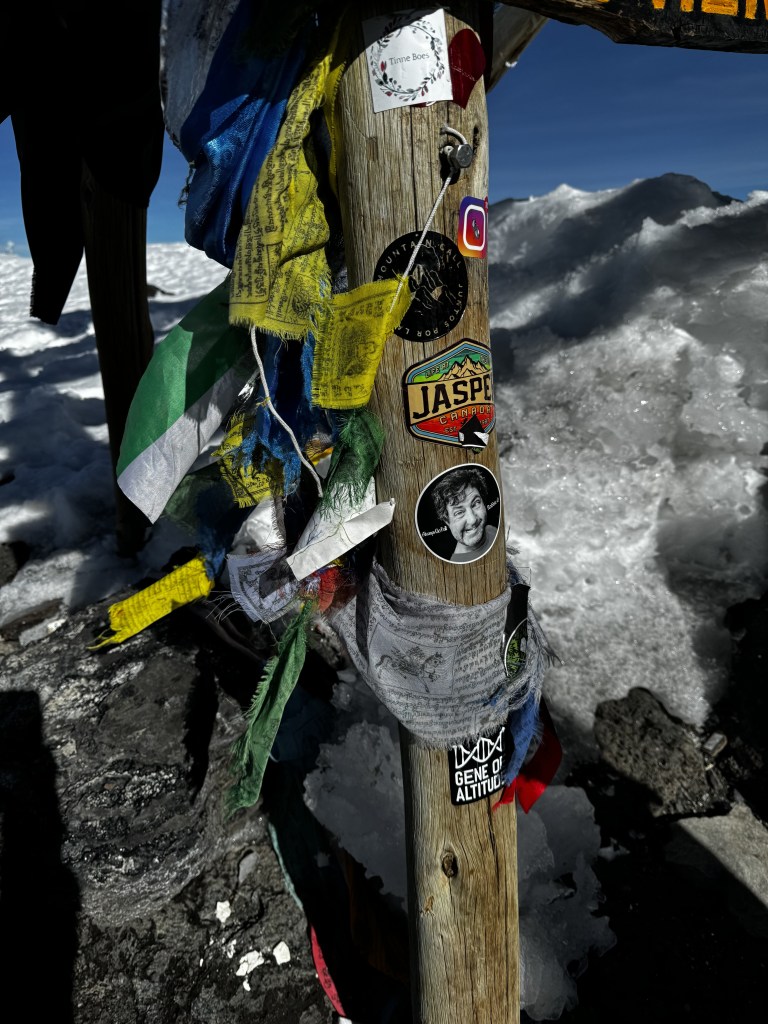
We reached Stella Point at 7:12am, the day had already broken, the sunrise came as we closed in on that landmark, we were moving forward, and I lifted my gaze from the ground to see the sun and the blaze orange and pink sky. I took a moment and took a zen photo, and in our shared folder of pictures there is one actual picture of this sky from Karen, a trekker from the UK. The actual picture does not translate the magnificence of the sky in my zen photo. A brief rest and we headed to Uhuru Peak, about an hour trek to the highest peak in Africa. We reached the summit at approximately 8:36am on the morning of January 31st. The sign was already littered with hikers taking pictures, we waited our turn, got the prerequisite picture with the sign then hiked up onto the glacier for one last picture. At this point I wandered off and found a small hole with a rock protruding and pulled from my pocket a small container of Rob’s ashes and left them on the glacier surrounding the small lava rock formation. I did this in Iceland too, leaving a small amount on the black pebble beach. He wasn’t a traveller or an adventure seeker unless there was a Donzi or motorcycle involved, but for me leaving a piece of him in these places felt cathartic.

The descent of Kilimanjaro was fast, one overnight at Millennium Camp, a desolate camp with no vegetation as it was ravaged by forest fires in 2022. The next morning a slippery, muddy descent to the gate and we were done!!! We had spent 8 days as a group of 5 hikers – myself, Kevin my brother, Cory a friend, Karen from the UK, and Nancy from Oregon (her husband Eugene had to stay behind as he developed a lung infection right before we were set to leave), and 23 Tanzanian staff – porters, cooks, and guides. The staff were amazingly sweet and generous people, always smiling and there to lend a hand.

A trip that will be in my memory, and my zen album for the rest of my life.

 LISA O
Leave a comment